The headline message from the Chancellor
The first ever female Chancellor, Rachel Reeves, delivered the first Labour budget in 14 years, vowing to protect the NHS, protect working people and rebuild Britain.
Below you will find all tax rates and allowances, plus stamp duty allowances for 2024-2025. Just click the buttons below for a PDF version of each
Key measures announced by the Chancellor in the Autumn Budget 2024 are summarised within this Guide.
Income tax
Personal tax thresholds – ie personal allowance, basic and higher-rate thresholds for income tax remain frozen until April 2028 at the current level of £12,570 and £50,270. The additional rate threshold was reduced from £150,000 to £125,140 from 6 April 2023. The Chancellor did announce that the thresholds will be uprated by inflation from April 2028 onwards.
Personal Allowance for higher rates from 2023/24
Where annual income exceeds £100,000, personal allowance is lost at a rate of £1 for every £2 of income above £100,000. This is the threshold where the entire personal allowance is lost.
The loss of the personal allowance means a person is taxed at 40% on the additional £2 of income, and they also pay an extra 40% on the £1 of personal allowance lost. This results in a marginal rate of 60%, which continues up to £125,140 (£100,000 + (£12,570 x 2)). At the £125,140 point the entire personal allowance is lost.
SDLT
From 31 October 2024 the Higher Rates for Additional Dwellings (HRAD) surcharge on Stamp Duty Land Tax (SDLT) will be increased by 2 percentage points from 3% to 5%.
Taxation of Employee Ownership Trusts and Employee Benefits Trusts
A package of reforms to the taxation of Employee Ownership Trusts and Employee Benefit Trusts will be legislated. These reforms will ensure that the regimes remain focused on encouraging employee ownership and rewarding employees, and to prevent opportunities for abuse. The changes will take effect from 30 October 2024.
Tax Treatment of double cab pick-up vehicles
Following a Court of Appeal decision, the government will not introduce legislation to maintain the treatment of double cab pick-up vehicles with a payload of one tonne or more as goods vehicles. HMRC is updating guidance to clarify the position in respect of such vehicles which will be treated as cars for capital allowances, for benefits in kind and for some deductions from business profits. Transitional arrangements will also apply.
Annual Uprating of the van benefit charge and the car and van fuel benefit charges for 2025 to 2026
The increases to the van benefit charge and the car and van fuel benefit charges will be using the September 2024 Consumer Prices Index (CPI).
The following new rates will come into effect from 6 April 2025:
- the van benefit charge will be £4,020 in tax year 2025 to 2026
- the van fuel benefit charge will be £769 in tax year 2025 to 2026
- the car fuel benefit charge multiplier will be £28,200 in tax year 2025 to 2026.
Taxation of company cars — the appropriate percentage for tax years 2028 to 2029 and 2029 to 2030
The government is setting company car tax rates for tax years 2028 to 2029 and 2029 to 2030:
- Appropriate percentages for zero emission and electric vehicles will increase by 2 percentage points per year in 2028 to 2029 and 2029 to 2030, rising to an appropriate percentage of 9% in tax year 2029 to 2030.
- Appropriate percentages for all cars with emissions of 1 to 50g of CO2 per kilometre, including hybrid vehicles, will rise to 18% in tax year 2028 to 2029 and 19% in tax year 2029 to 2030.
- Appropriate percentages for all other vehicle bands will increase by 1 percentage point per year in tax years 2028 to 2029 and 2029 to 2030. This will be to a maximum appropriate percentage of 38% for tax year 2028 to 2029 and 39% for tax year 2029 to 2030.
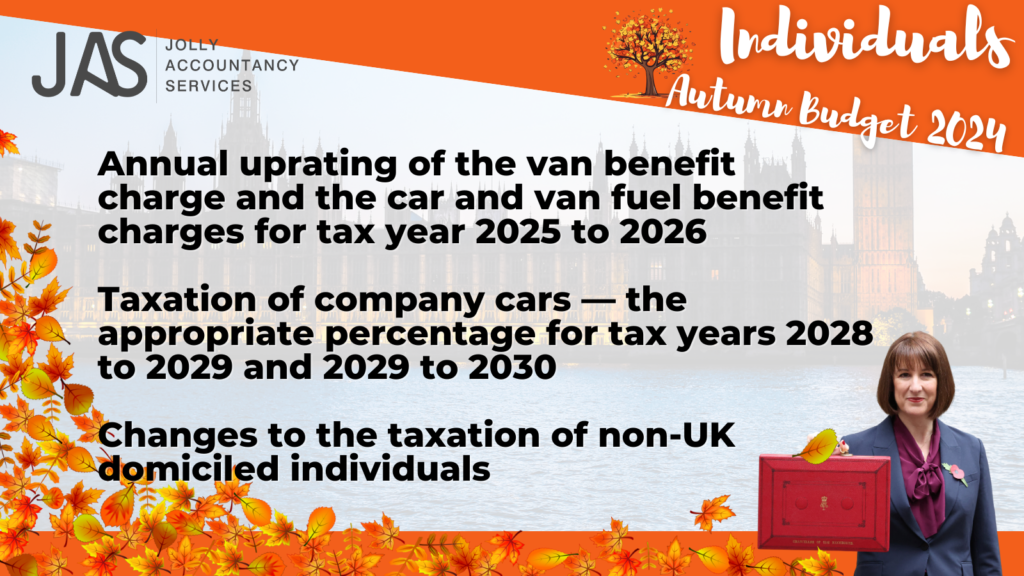
Changes to the taxation of non-UK domiciled individuals
The government will introduce legislation in Finance Bill 2024-25, abolishing the remittance basis of taxation for non-UK domiciled individuals and replacing it with a residence-based regime, which will take effect from 6 April 2025.
Individuals who opt into the regime will not pay UK tax on foreign income and gains (FIG) for the first four years of tax residence. From 6 April 2025, the government will introduce a new residence-based system for Inheritance Tax.
Corporation Tax
The corporate tax roadmap confirms the major features of the Corporation Tax regime for the duration of this Parliament including:
- capping the headline rate of Corporation Tax at 25%
- maintaining the Small Profits Rate and marginal relief at their current rates and thresholds
- maintaining permanent full expensing
- maintaining the £1m Annual Investment Allowance, writing down allowances, and the Structures and Buildings Allowance
- maintaining the rates for the merged R&D Expenditure Credit scheme and the Enhanced Support for R&D Intensive SMEs
- maintaining the Patent Box.
Making Tax Digital
Making Tax Digital (MTD) for Income Tax will be extended to sole traders and landlords with income over £20,000 by the end of this Parliament. This expands the rollout of MTD for Income Tax, which is April 2026 for sole traders and landlords with income over £50,000 and April 2027 for those with income over £30,000.
Inheritance Tax
IHT thresholds have been frozen until 2030. In addition, significant restrictions on agricultural and business property relief are proposed from April 2026. Unused pension funds and death benefits will be included in estates from April 2027.
Capital Gains Tax
Effective 30 October 2024, the main rates of Capital Gains Tax and carried interest will increase from 10% to 18% and from 20% to 24%. The rate for trustees and personal representatives will rise from 20% to 24%, while the existing rates for residential property (18% and 24%) will remain unchanged.
From 6 April 2025, the rate for Business Asset Disposal Relief and Investors’ Relief will increase from 10% to 14%. This will further rise from 14% to 18% on 6 April 2026. The Investors’ Relief lifetime limit will be reduced from £10m to £1m for qualifying disposals made on or after 30 October 2024.
Private equity managers will have to pay 32% tax on their carried interest gains from April 2025
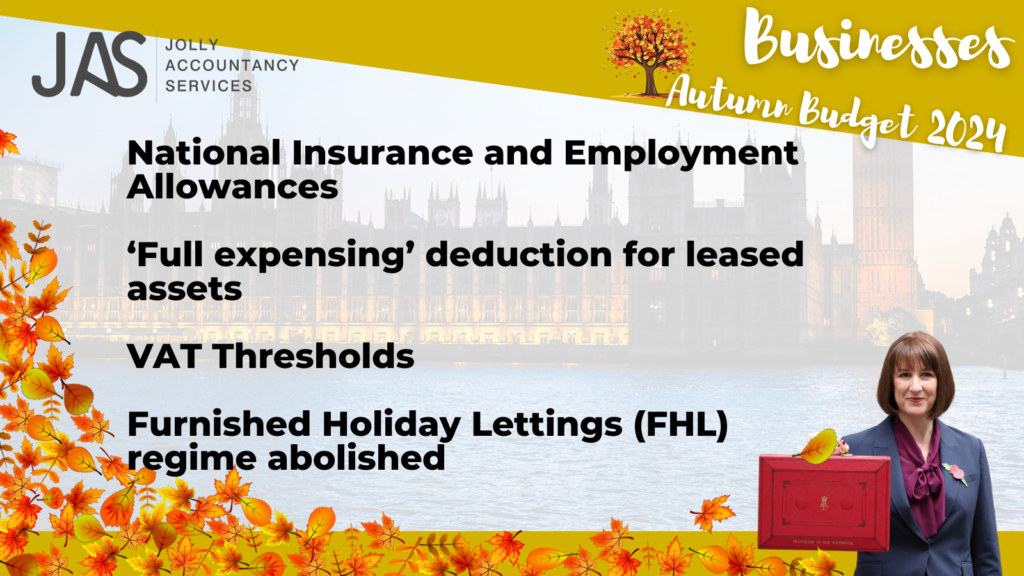
National Insurance and Employment allowance
From 6 April 2025, the rate of employer National Insurance Contributions (NICs) for Classes 1, 1A and 1B will rise by 1.2 percentage points to 15%.
The threshold at which employers start to pay NICs will decrease from £9,100 to £5,000 per year.
The government will increase the Employment Allowance from £5,000 to £10,500 and remove the previous £100,000 threshold, making it available to all eligible employers.
Capital Allowances: Key Features to be Maintained
The government will maintain key features of the capital allowances regime, including full expensing with a 100% first-year allowance for qualifying new main rate plant and machinery, and a 50% first-year allowance for special rate machinery, making the UK the only major economy with permanent full expensing.
The Annual Investment Allowance will continue to offer 100% first-year relief for plant and machinery investments up to £1m for all businesses, including unincorporated ones.
Writing down allowances will remain flexible, allowing businesses to choose which allowances to claim for main and special rate machinery.
Additionally, the Structures and Buildings Allowance will provide relief for capital expenditure on the purchase, construction, and renovation of new non-residential structures and buildings.
‘Full expensing’ deduction for leased assets
The Chancellor announced an intention to include full expensing tax relief on leased assets. The relief will enable businesses to be more efficient by leasing assets to nurture productivity by getting the newest, cleanest and most efficient plant and machinery into the hands of business owners. No timeline for the start of the relief has been announced and the relief is subject to draft legislation to be published
VAT Thresholds
From 1 April 2024 the taxable turnover threshold which determines whether a person must be registered for VAT was increased from £85,000 to £90,000. The taxable turnover threshold which determines whether a person may apply for deregistration was increased from £83,000 to £88,000. No further changes were announced.
Additional resources for HMRC
The government is continuing to tackle tax non-compliance by making further investments, including in HMRC’s capacity to collect tax debts. The government is building on strong actions at recent fiscal events, including measures to clamp down on promoters of tax avoidance, and is now going further to strengthen taxpayer protections, making it harder for bad actors to provide tax advice that could cause harm. The government is consulting both on options to strengthen the regulatory framework in the tax advice market, and on requiring tax advisers to register with HMRC if they wish to interact with HMRC on a client’s behalf.
The government has also indicated it is investing in improving HMRC’s customer services, providing the resource needed to meet performance targets, including answering 85% of phone calls where the taxpayer wants to speak to an adviser. The government will transform HMRC into a digital-first organisation, with a Digital Transformation Roadmap to be published in spring 2025.
If you are unsure about anything you have read or you would like some advice, please get in touch. I’d be happy to help.

I am the sole Director of the practice and my name is Sonya Jolly.
I qualified as a chartered certified accountant in 2000 and have over 20 years of general practice experience.
I have always worked with small owner-managed businesses and individuals and feel my approach allows me to develop lasting relationships with clients, providing them with all their accountancy and taxation needs and requirements.