This Guide summarises the key measures announced by the Chancellor in the Autumn Budget 2025.
Rachel Reeves has delivered her second Autumn Budget, continuing Labour’s pledge to protect public services, support working households and steer the economy towards long-term stability.
Download a quick summary here:
Key Headlines at a Glance
- Tax thresholds frozen until 2030/31, including the personal allowance and higher-rate thresholds, extending the freeze by two more years.
- Dividend tax increases from April 2026, with basic and higher rates rising by 2%.
- Savings and property income tax rates rise from April 2027, increasing the basic, higher and additional rates by 2 percentage points.
- Pension salary sacrifice NIC relief capped at £2,000 from April 2029.
- Electric vehicle tax changes continue, including higher company car benefit rates and a new pay-per-mile EV charge from 2028.
- State Pension rises by 4.8% in April 2026, with simplified administration for pensioners from 2027/28.
- Self-assessment payments to be made more frequently via PAYE from April 2029 for those with mixed PAYE and self-employed income.
- ISA cash limit reduced to £12,000 from April 2027 (overall ISA limit remains £20,000).
- Corporation tax regime unchanged, with permanent full expensing, the 25% main rate cap and the £1m AIA all confirmed.
- Penalty regime toughened: late-filing penalties for corporation tax returns will double from April 2026.
- MTD expanded, with all traders and landlords earning over £20,000 brought into MTD by the end of this Parliament; some groups deferred by one year.
- National Minimum Wage increases significantly from April 2026, with NLW rising to £12.71 per hour.
- New youth employment guarantee: a six-month paid work placement for eligible 18–21-year-olds on Universal Credit.
- Business rates reforms continue, including a new high-value multiplier for properties over £500,000 from April 2026.
- IHT thresholds frozen to 2030/31, with relief allowances uprated from 2031.
- CGT increases for Business Asset Disposal Relief and Investors’ Relief to 14% in April 2025 and 18% in April 2026.
- CGT relief on disposals to Employee Ownership Trusts cuts from 100% to 50% from November 2025.
- Capital allowances strengthened, including a new 40% First-Year Allowance from January 2026 and writing-down allowance cut to 14%.
- VAT thresholds unchanged, with the registration limit remaining at £90,000.
- HMRC investment boosted with £89m to increase tax-debt collection, a £25m Insolvency Service expansion and a new Phoenixism Taskforce.
Several measures reinforce or expand policies first introduced in the 2024 Autumn Budget.

Personal Tax – What’s Changing
Income Tax (England, Wales & Northern Ireland): Threshold Freeze and Higher Rates Ahead
Income tax bands and personal allowance remain frozen until 2030/31, extending the previously announced freeze past 2028. The personal allowance stays at £12,570, with the higher-rate threshold fixed at £50,270.
The additional rate threshold remains at £125,140, with the taper still creating an effective 60% marginal tax band between £100,000 and £125,140.
Dividend Tax
From April 2026, dividend tax rates will rise:
-
Ordinary rate: 10.75% (up from 8.75%)
-
Upper rate: 35.75% (up from 33.75%)
-
Additional rate unchanged at 39.35%
Savings & property income tax
From April 2027:
-
Basic rate increases 20% → 22%
-
Higher rate 40% → 42%
-
Additional rate 45% → 47%
National Insurance: New Cap on Pension Salary Sacrifice Relief
From April 2029, the amount of pension contributions that can be made via salary sacrifice NIC-free will be capped at £2,000 per year. Contributions above this will attract employee and employer NICs.
Salary sacrifice for Child Benefit and Tax-Free Childcare remains permitted.
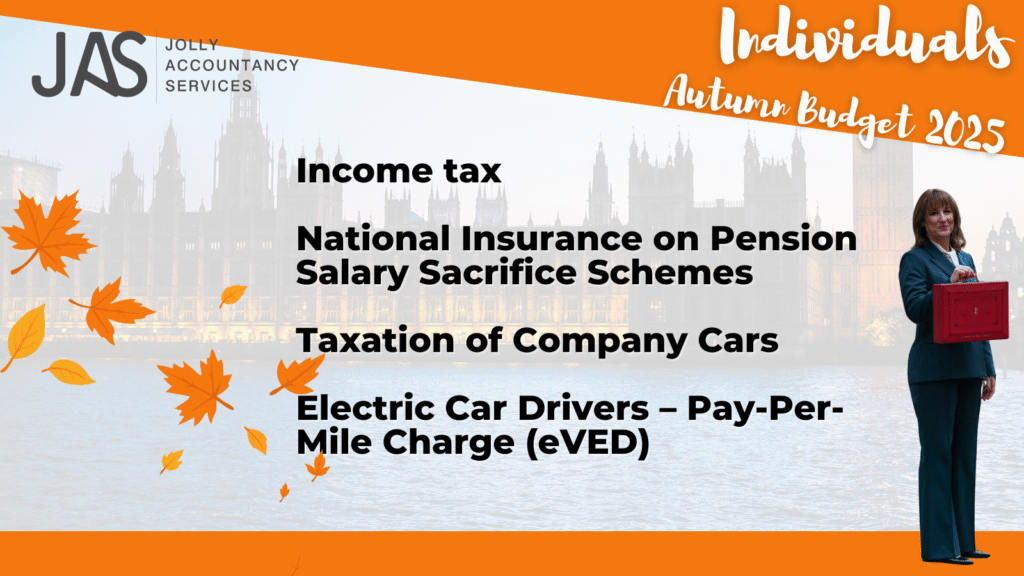
Company Cars: Higher Benefit-in-Kind Rates from 2028
Company car tax rates for 2028/29 and 2029/30 rise as previously planned:
-
EVs increase by 2 percentage points per year, reaching 9% by 2029/30
-
Hybrid cars (1–50g/km) rise to 18% then 19%
-
All other cars increase by 1% per year (max 39%)
A new EV mileage charge (eVED) starts April 2028:
-
3p per mile for battery electric cars
-
1.5p per mile for plug-in hybrids
Company Cars: Higher Benefit-in-Kind Rates from 2028
Company car tax rates for 2028/29 and 2029/30 rise as previously planned:
-
EVs increase by 2 percentage points per year, reaching 9% by 2029/30
-
Hybrid cars (1–50g/km) rise to 18% then 19%
-
All other cars increase by 1% per year (max 39%)
A new EV mileage charge (eVED) starts April 2028:
-
3p per mile for battery electric cars
-
1.5p per mile for plug-in hybrids
State Pension: Uprating and Changes to Simple Assessment
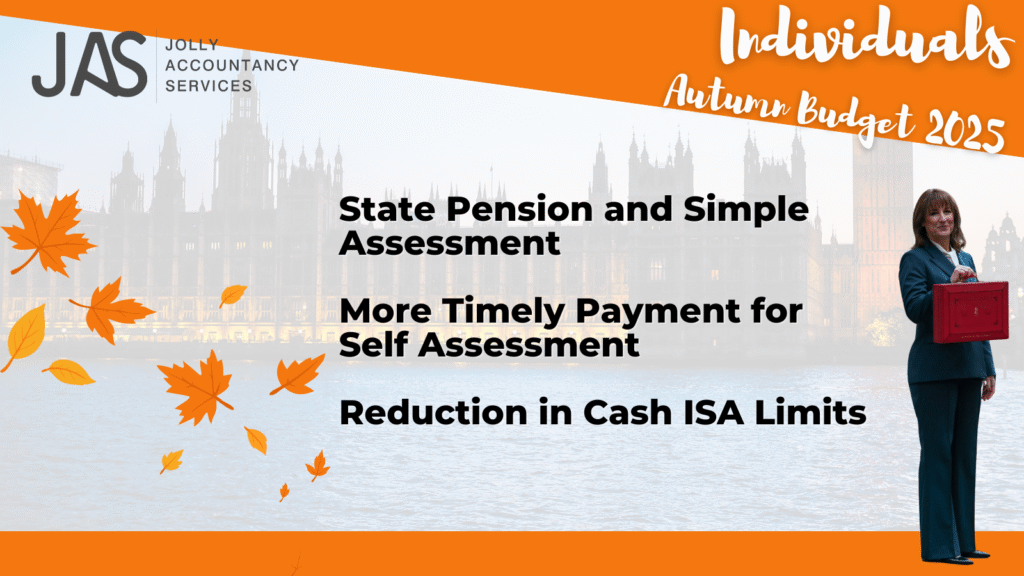
The basic and new State Pension will rise by 4.8% from April 2026.
From 2027/28, pensioners receiving only the State Pension will no longer need to complete a Simple Assessment if their pension exceeds the personal allowance — HMRC will automate the process.
Self-Assessment: Tax Payments to Become More Frequent
From April 2029, taxpayers with PAYE + self-assessment income will pay part of their ITSA liability through PAYE during the year, based on previous years’ tax. This brings tax payments closer to real time but does not increase the overall tax due. Consultations on wider reforms begin in 2026.
ISAs: Cash ISA Allowance Reduced from 2027
From 6 April 2027, the cash ISA limit reduces to £12,000, within the existing £20,000 ISA total limit.
Savers aged 65+ may still save £20,000 per year in a cash ISA. Other ISA limits remain unchanged until 2031.

Business Tax – Impact on SMEs & Limited Companies
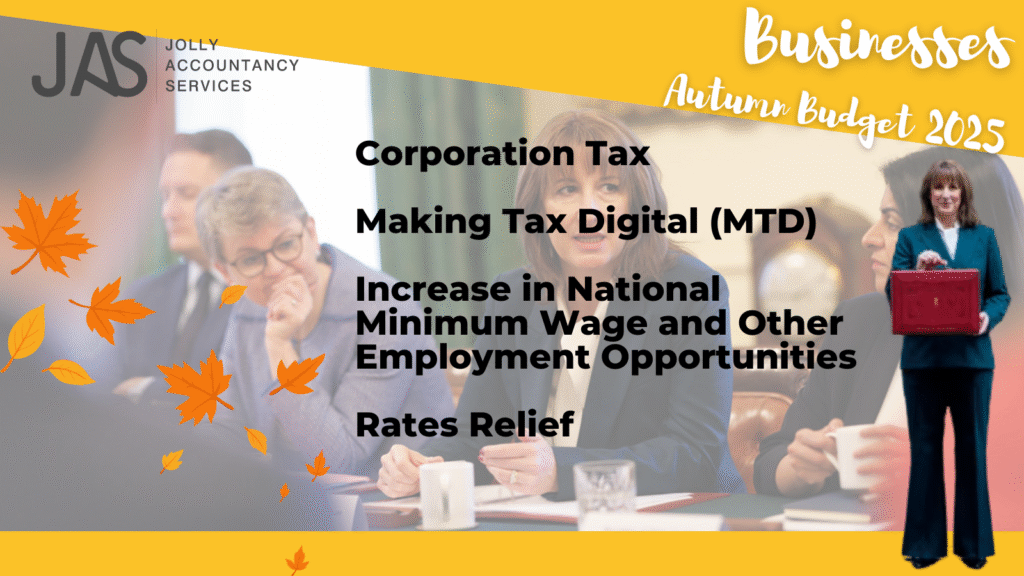
Corporation Tax: Main Rate Capped and Full Expensing Maintained
The Government confirmed the existing corporate tax roadmap:
-
Headline rate capped at 25%
-
Small Profits Rate unchanged
-
Permanent full expensing maintained
-
£1m Annual Investment Allowance retained
-
Patent Box and enhanced R&D support continue
Additional announcements include:
-
Late filing penalties for CT returns will double from 1 April 2026
-
Consultation in 2026 on standardising digital CT computation submissions
-
Clarified CT treatment of intra-group payments for RDEC/AVEC/VGEC from 26 Nov 2025
-
100% FYA on zero-emission cars and EV charge-point plant extended to March/April 2027
Making Tax Digital (MTD): Who Must Join and When
MTD for Income Tax continues its phased rollout:
-
2026: income over £50,000
-
2027: income over £30,000
-
By end of Parliament: over £20,000
New rules include a one-year deferral for certain groups such as trustees, care relief claimants, and foreign entertainers. Those under a Court of Protection deputyship will be permanently exempt.
National Minimum Wage: Significant 2026 Increase
From 1 April 2026:
-
NLW rises 4.1% to £12.71 per hour
-
18–20 year olds: £10.85 (up 8.5%)
-
16–17 year olds & apprentices: £8.00 (up 6%)
Employing a full-time worker aged 21+ is estimated to cost employers over £30,000 per year after the increase.
Youth Employment: New Six-Month Work Placement Guarantee
The Government also announced a six-month paid work placement guarantee for eligible 18–21-year-olds on Universal Credit for 18 months.
Business Rates: New Rules for High-Value Properties
From 1 April 2026:
-
A new high-value business rates multiplier applies to properties with RV over £500,000
-
The multiplier will be 50.8p in 2026/27 (2.8p above the standard rate)
Additional measures:
-
Two-year extension of Small Business Rates Relief for firms expanding into a second property
-
A new consultation reviewing barriers to investment and valuation methodology concerns
Inheritance Tax (IHT): Threshold Freeze and Future APR/BPR Adjustments
- Thresholds (NRB, RNRB) frozen until 2030/31
-
APR and BPR £1m allowance uprated with CPI from 2031
-
Unused pension funds & death benefits included in estates from April 2027 (previously announced)
Capital Gains Tax (CGT): Higher Rates and Reduced Reliefs
Upcoming changes include:
-
Business Asset Disposal Relief and Investors’ Relief rise to 14% in April 2025 and 18% in April 2026
-
Investors’ Relief lifetime limit reduced to £1m
-
CGT relief for disposals to Employee Ownership Trusts reduces from 100% → 50% for disposals on or after 26 November 2025
Capital Allowances: New 40% FYA and Lower Writing-Down Allowances
The Government continues with permanent full expensing:
-
100% FYA (main-rate plant & machinery)
-
50% FYA (special rate)
-
£1m AIA
-
Flexible writing-down allowances
-
Structures & Buildings Allowance
New for 2026:
-
A 40% First-Year Allowance for certain main-rate assets from 1 January 2026
-
Writing-down allowance drops from 18% → 14% from April 2026
VAT: Thresholds Remain Unchanged
No changes to VAT thresholds or rates.
Registration stays at £90,000; de-registration at £88,000.
HMRC & Compliance
- £89m investment to expand debt-collection capacity
-
£25m for Insolvency Service expansion
-
New Abusive Phoenixism Taskforce to tackle directors who evade tax through insolvency abuse
-
Plans to update the Company Directors Disqualification Act
-
Ongoing transition to a digital-first HMRC, with a transformation roadmap expected spring 2026

Other Announcements: HMRC Enforcement & Tackling Fraud
The Budget included several measures aimed at strengthening HMRC’s ability to recover unpaid tax and clamp down on abuse of the insolvency system. These changes are designed to improve compliance, deter rogue behaviour, and increase the Government’s capacity to pursue tax debts more effectively.
HMRC Funding Boost: £89m to Strengthen Tax Debt Collection
The Government will invest £89 million over the next five years to expand HMRC’s workforce and increase its capacity to collect outstanding tax debt. This represents a continued shift towards stronger enforcement and more proactive debt-recovery activity.
New ‘Abusive Phoenixism Taskforce’ created
A dedicated new taskforce will target individuals who deliberately use insolvency processes to avoid paying tax and write off liabilities.
The Government will fund the recruitment of 50 additional Insolvency Service staff for this purpose, focusing on identifying, investigating and disqualifying directors who repeatedly shut down companies to escape debts.
Stronger powers to disqualify rogue directors
To reinforce this crackdown, the Government will also:
-
Invest a further £25 million over five years to expand the Insolvency Service
-
Amend the Company Directors Disqualification Act 1986, widening the circumstances in which directors can be disqualified for misconduct
-
Bring these changes forward in a future Finance Bill
These measures reflect a broader push to deter fraudulent behaviour and protect creditors, including HMRC.
If you are unsure about anything you have read or you would like some advice, please get in touch. I’d be happy to help.

I am the sole Director of the practice and my name is Sonya Jolly.
I qualified as a chartered certified accountant in 2000 and have over 20 years of general practice experience.
I have always worked with small owner-managed businesses and individuals and feel my approach allows me to develop lasting relationships with clients, providing them with all their accountancy and taxation needs and requirements.